It’s out! A Guide to the Battle of Bennington and the Bennington Monument, 56 pages long and illustrated with 37 color maps, photographs, and artworks, was published on Battle Day itself (August 16) by West Mountain Press and is now available in outlets in Bennington and Manchester, Vermont, and online through the Northshire Bookstore (northshire.com). A local paper quoted me as follows: “I thought,” says Holland, “that visitors to Bennington – and all of us who live here, for that matter – needed a popular guide to a battle that helped shape the course of American history. The more I learned about it myself, the more fascinated I became. The personalities, tactics, and the way the fighting played out in real time – if I were making a movie of it, I wouldn’t change a thing.”
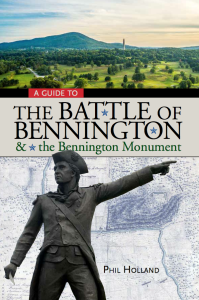
I had a great time researching it, writing it, finding the images I wanted to use, and playing a bit part in putting it all together – the major role once again went to Leslie Noyes, who designed a really attractive book. She also suggested my hiring the drone photographer (David Barnum) who took the top cover photo of the landscape around the Monument and a great one inside closer up. Now, to sell them (you may also order direct from me: $12.95 plus $3.99 first-class shipping, payable by check to me at 72 Grouse Lane, Shaftsbury, VT 05262; VT residents add 78 cents sales tax).
I promised a bibliography. Here it is:
This bibliography is divided into four parts: 1) on the Battle and related matters 2) on Daniel Redding 3) On the Bennington Monument 4) on Grandma Moses.
- On the Battle and related matters:
Anburey, Thomas, Travels through the interior parts of America, Houghton Mifflin, Boston, 1923.
Barker, Tom, “Loyalism in Rensselaer County,” The Symposium on the Battle of Bennington, Hoosick Township Historical Society, October, 2000, http://www.hoosickhistory.com/shortstories/BattleSymposium.htm
Barbieri, Michael, “Bennington Fatally Delays Burgoyne,” Journal of the American Revolution, June 11, 2013, https://allthingsliberty.com/2013/06/bennington-fatally-delays-burgoyne/
Bassett, T. D. Seymour, “Vermont’s Nineteenth-Century Civil Religion,” Proceedings of the Vermont Historical Society, Winter-Spring, 1999, vol. 67, nos. I & 2, pp. 27-53, https://vermonthistory.org/journal/misc/CivilReligion.pdf
“Battle of Bennington,” Bennington Banner, Nov. 28, 1889, http://chroniclingamerica.loc.gov/lccn/sn84022639/1889-11-28/ed-1/seq-2/
Bennington Battlefield State Historic Site, http://nysparks.com/historic-sites/12/details.aspx
Bennington, Postcard History Series, Bennington Historical Society and Bennington Museum, Acadia Publishing, Charleston, S.C., 2014.
Corbett, Theodore, No Turning Point, University of Oklahoma Press, Norman, OK, 2012.
Cubbison, Douglas R., Burgoyne and the Saratoga Campaign: His Papers, University of Oklahoma Press, Norman, OK, 2014.
Foster, Herbert D., and Thomas W. Streeter, “Stark’s Independent Command At Bennington,” Proceedings of the New York State Historical Association, vol. 5 (1905), pp. 24-95, Published by the New York State Historical Association, http://www.jstor.org/stable/42889850
Gabriel, Michael P., “I Did Not Hear a Single Shot Fired”: A Reevaluation of Lieutenant-Colonel Heinrich Breymann’s March to Bennington,” Hessians: Journal of the Johannes Schwalm Historical Association, August 2013, vol. 16, p. 37. http://connection.ebscohost.com/c/articles/91969017/did-not-hear-single-shot-fired-reevaluation-lieutenant-colonel-heinrich-breymanns-march-benningtonhttp://eds.b.ebscohost.com.hrt-proxy.libraries.vsc.edu/ehost/pdfviewer/pdfviewer?vid=3&sid=9b8714a9-708e-4a8b-9a53-d23acb6ae84f%40sessionmgr105&hid=126
Gabriel, Michael P., “We Were at the Bennington Battle,” Walloomsack Review, vol. 4, pp. 30-46.
Gabriel, Michael P., The Battle of Bennington: Soldiers and Civilians, The History Press, Charleston, SC, 2012.
Hadden, James Murray, Hadden’s journal and orderly books: a journal kept in Canada and upon Burgoyne’s campaign in 1776 and 1777, Albany, N.Y., J. Munsell’s Sons, 1884, https://archive.org/details/haddensjournalor00hadd
Hall, Hiland, and Hall, N.B., Vermont Historical Magazine, pp. 136-181, http://www.rootsweb.ancestry.com/~vtwindha/vhg1/0135_bennington.htm
Houghton, George Frederick, and James Davie Butler, Addresses on the Battle of Benningtonand the Services of Col. Seth Warner, Burlington, VT, 1849, Leopold Classic Library.
Ingrao, Charles W., The Hessian mercenary state: ideas, institutions, and reform under Frederick II, 1760-1785 (Cambridge University Press, 2003)
Kelleher, Sean, “Q&A: Douglas Cubbison on British General Burgoyne,” The New York History Blog, June 27, 2012, http://newyorkhistoryblog.org/2012/06/27/qa-douglas-cubbison-on-british-general-burgoyne/
Ketchum, Richard M, Saratoga, Henry Holt and Company, New York, 1997.
http://www.littlebrownjug.net
“Lorimier, Claude-Nicolas-Guillaume De,” Dictionary of Canadian Biography, http://www.biographi.ca/en/bio/lorimier_claude_nicolas_guillaume_de_6E.html
Lowell, Edward J. (1884), The Hessians, New York: Harper & Brothers
Luzader, John F., Saratoga: A Military History of the Decisive Campaign of the American Revolution, Savas Beatie LLC, New York, 2010.
Miles, Lion G, “The Loyalists at the Battle of Bennington,” The Symposium on the Battle of Bennington, Hoosick Township Historical Society, October, 2000, http://www.hoosickhistory.com/shortstories/BattleSymposium.htm
Mintz, Max M., The Generals of Saratoga, Yale University Press, New Haven, 1992.
“The Northern Journey of Jefferson and Madison,” National Archives, Founders Online, http://founders.archives.gov/documents/Jefferson/01-20-02-0173-0001
Parks, Joe, “New York’s Part in the Battle of Bennington,” The Symposium on the Battle of Bennington, Hoosick Township Historical Society, October, 2000, http://www.hoosickhistory.com/shortstories/BattleSymposium.htm
Riedesel, Friederike Charlotte Luise von Massow, Memoirs, letters, and journals of Major General Riedesel, Chapel Hill, 1965.
Riedesel, Friedrich Adolf, Memoirs, letters, and journals of Major Heneral Riedesel, New York, 1969.
Regiment von Riedesel, http://vonriedesel.weebly.com/history.html
Rindfleisch, Bryan, “The Stockbridge-Mohican Community, 1775-1783, Journal of the American Revolution, Feb. 3, 2016,
https://allthingsliberty.com/2016/02/the-stockbridge-mohican-community-1775-1783/
Rose, Ben Z., John Stark, Maverick General, Treeline Press, 2007.
Saratoga National Historical Park, https://www.nps.gov/sara/index.htm
Smith, Richard B., The Revolutionary War in Bennington County, A History and Guide, The History Press, Charleston, SC, 2008.
Stark, Caleb,
| Stevens, Lauren R., “The Hoosic Matters: A Brief History of the Hoosac Valley,” http://www.williamstownhistoricalmuseum.org/wp-content/uploads/2014/12/Hoosic-History-12_2014.pdf
Sultzman, Lee, “Mahican History,” http://www.dickshovel.com/Mahican.html
Tokar, Major John A., “Logistics and the Defeat of Gentleman Johnny,”
Stephenson, Michael, Patriot Battles, Harper Collins, New York, 2007. |
http://www.almc.army.mil/alog/issues/julaug00/ms516.htm
Valosin, William, and Eric Schnitzer, personal communication, July 2016.
Ward, Christopher, The War of the Revolution, 1952.
Wasmus, J.F., An Eyewitness Account of the American Revolution and New England Life: The Journal of J.F. Wasmus, German Company Surgeon, 1776-1783, trans. Helga Doblin, ed. Mary C. Lynn, Praeger, Westport, VT. 1990.
Webler, Robert M., “German (So Called Hessian) Soldiers Who Remained In Massachusetts And Neighboring States, Particularly After The Battles Of Bennington And Saratoga,” Hessians: Journal of the Johannes Schwalm Historical Association, http://jsha.org/articles/082-088_Webler.pdf
- On Daniel Redding
Bennington Museum archives, Bennington VT.
Burleigh, H.C., “The Sad Story of the Reddens,” https://archive.org/stream/hcbreddensbyburleigh/hcbreddensbyburleigh_djvu.txt
Metcalfe, Wynn, personal communication, Aug. 1, 2016.
Spargo, John, The Story of David Redding Who Was Hanged, Bennington Historical Society, Bennington VT, 1945.
Watt, Gavin, personal communication
- On the Bennington Monument:
The American Architect and Building News, vol. 18, no. 504, August 22, 1885. https://books.google.com/books?id=xBQvAQAAIAAJ&pg=PA85&lpg=PA85&dq=entasis+bennington+battle+monument&source=bl&ots=8nDb6TtDEe&sig=XAh6i6sm74tnf3j81QBBgwxt6qM&hl=en&sa=X&ved=0ahUKEwiup7eWwJvNAhUKVz4KHdEfBuAQ6AEINjAE#v=onepage&q=entasis%20bennington%20battle%20monument&f=false
“Battle Monument” in SAH Archipedia, eds. Gabrielle Esperdy and Karen Kingsley, Charlottesville: UVaP, 2012—, http://sah-archipedia.org/buildings/VT-01-BE23.
http://benningtonbattlemonument.com
Bennington Museum archives.
Chicote, Marylou, personal communication, July 2016.
Gordon, John Steele, Washington’s Monument, Bloomsbury, NY, 2016.
Laying of the Cornerstone (program, August 16, 1887), Bennington VT.
Resch, Tyler, Bennington’s Battle Monument: Massive and Lofty, Beech Seal Press, Bennington, VT, 1993.
Spargo, John, The Bennington battle monument; its story and its meaning,” The Tuttle Company, Rutland, VT, 1925. https://archive.org/stream/benningtonbattle00spar/benningtonbattle00spar_djvu.txt
Weeks, Lyman H., “Description of the Monument,” Bennington Banner, Aug. 18, 1887.
- On Grandma Moses:
Cotter, Holland, “The Fenimore Art Museum Reconsiders an American Idol Named Grandma Moses,” The New York Times, Aug. 4, 2006, http://www.nytimes.com/2006/08/04/arts/design/04mose.html
Grandma Moses, American Modern, Shelburne Museum, Bennington Museum, Skira Rizzoli, New York, 2016.
Franklin, Jamie, personal communication, July 22, 2016.
“Grandma Moses to Give DAR Painting of Famous Battle,” Prescott Evening Courier, Oct. 19, 1953, https://news.google.com/newspapers?id=XV4nAAAAIBAJ&sjid=608DAAAAIBAJ&pg=4558%2C5048917
Kallir, Jane, et al., Grandma Moses in the 21st Century, Yale University Press, New Haven, 2001.
Kallir, Otto, Grandma Moses, Harry N. Abrams, New York, 1973.
Marling, Karal Ann, Designs on the Heart, the Homemade Art of Grandma Moses, Harvard University Press, Cambridge, 2006.
Robertson, Mary Ann (Grandma Moses), Grandma Moses, My Life’s History, Harper, New York. 1952.
Peter Schjeldahl, “The Original,” The New Yorker, May 28, 2001.
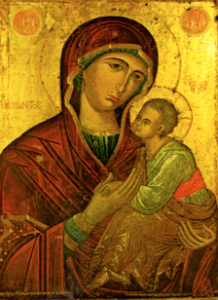
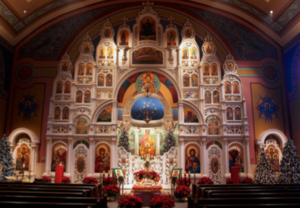 Andy Warhol’s artistic baptism also took place there. A sickly child, he also enjoyed reading movie magazines in bed during the week. The combination of Byzantium and Hollywood produced our foremost American icon painter.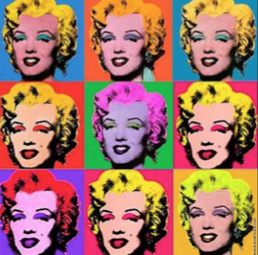

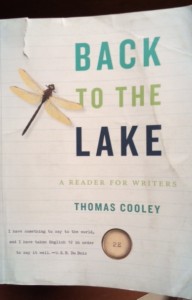
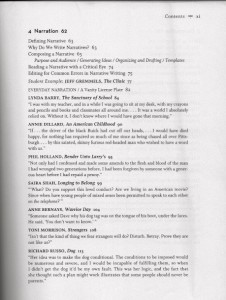 logy, but I was able to see the names of some heavy hitters (Dillard, Russo, E.B. White) in proximity to my own. The publisher had neglected to inform me that I had become a classic author. I suppose the Times had given permission to reprint my piece. No mysterious royalty payments have arrived in my bank account. I was the last to know.